Showing posts with label Literacy. Show all posts

Sunday, January 5, 2014

A look into my Reading Rotations


Below is a lesson that I submitted for a class I'm currently taking. It explains one teacher led rotation. It's a little formal, but I thought that it might be an interesting insight into how I use Reading Rotations and Ipads in my class this year with Blended Learning! Enjoy! 
______________________________________________________________________________________
(Once a day, my students participate in what we call Reading Rotations. Students rotate through 3 stations for 20 minutes each. In one station, students meet with a teacher. Monday through Wednesday the teacher runs guided reading groups with leveled readers. Thursdays and Fridays the teacher leads students in learning new apps on the iPad or in utilizing alternating reading apps including but not limited to “Endless ABC,” “Educreations,” and “Storykit.”
In another station, students are asked to complete what is called the Paper Station. The Paper station likewise alternates throughout the week. Mondays and Tuesdays are worksheets that are designed to assess students’ understanding of a phonics skill. Wednesdays asses parts of speech and and/or sentence structure and Thursdays and Fridays are left for word making manipulatives and Free Choice or prompted Journal Writing.
The Final Station that students participate in each day during this rotation time is the IPad Station. In this station, students are given a choice of taking Accelerated Reading Quizzes, working on RAZ kids or taking pre-determined quizzes on Scootpad. Occasionally I mix it up and require they use a discussion board app like Lino.)
The Lesson below comes from one part of my Teacher station. It shows how I might use the apps “story kit” and “flash cards” to work with my students on reading and writing the past tense of irregularly spelled verbs.
Content Area:  English Language Arts
CCSS.ELA-Literacy.L.2.1d Form and use the past tense of frequently occurring irregular verbs (e.g., sat, hid, told).
Objective:
  • SWBAT identify the past tense of frequently occurring irregular verbs.
  • SWBAT rewrite present tense verbs in the past tense within their own writing.
Procedure:
The learning center I have created utilizes the app Story kit and the app Flash cards. Students will work with a teacher in a small group during Reading Rotations. Focus for the small group instruction lends itself from an earlier whole class led instruction time and attempts to meet students in that group’s needs. This lesson will start with the teacher playing a short game with the students on her teacher iPad using the app, “Flashcards”. The teacher will show the present tense form of a verb. Students will as a group determine the past tense. When they have decided on an answer they will press the app and watch the card flip over to see if they are correct. After playing the game for 4 minutes, students will open the app, “Story kit.” They will create a new book, and title it, “Today and yesterday.”  The teacher will give them a present tense verb. They will create a sentence following the format on page 1, “Today I (present tense verb).“ They will then flip to page 2, and create a new sentence following the format, “Yesterday I (past tense of the verb.) They will complete a total of 8 pages for 4 verbs. They will be given a choice during their Ipad station the following day to illustrate their pages. (To differentiate further within group… teacher will assign different verbs to different students for the story kit portion of the center)
Materials Needed:
  • 1 iPad per student in group (about 4 to 5)
  • One teacher iPad
  • Story kit app on student iPads
  • Flashcards app on Teacher iPads

Assessment/ Review
Teacher will observe the discussion during the flashcards activity, identifying which students in the group quickly come to the answer and which need more time or practice with determining the past tense of irregularly formed verbs. She will record her observations.
Teacher will also observe the students’ created verb books.
Teacher will encourage during a share time for students to swap iPads with others, review and read each other’s “Today and Yesterday” books. 

Monday, November 25, 2013

October Learning

I love Halloween!  I love Halloween stories. I love Halloween traditions and I love creating Halloween Art. Integrating reading, writing and learning with Halloween is so much fun as a teacher! 

I know that its already halfway through November but I wanted to post some of the fun stuff we worked on in October.

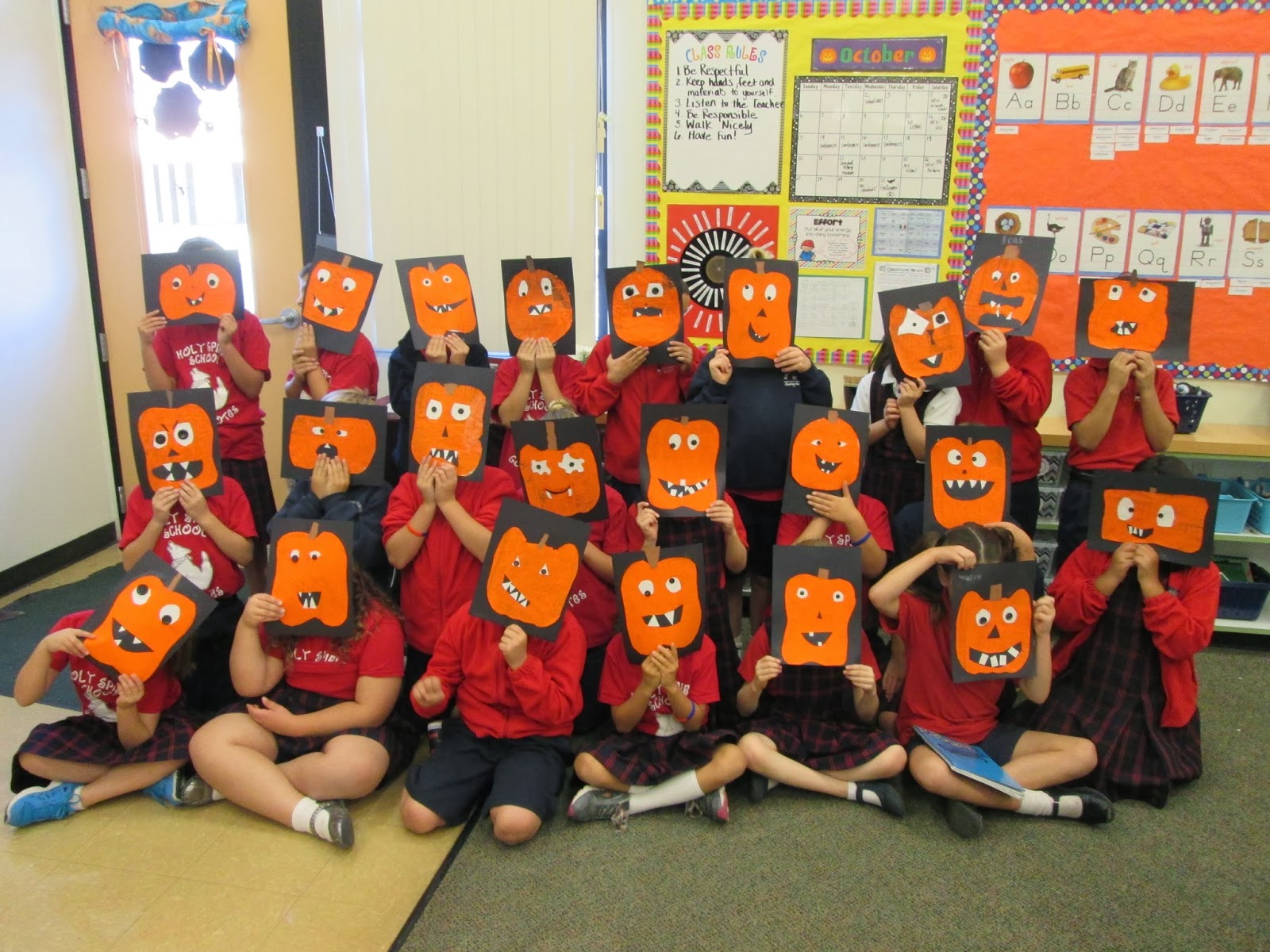
Below are images from our "pumpkin" making project. After reading the story, "Two many pumpkins" by Linda White, we worked on character development. We talked about the character Rebecca Estelle and her part in the story. We also discussed different reading strategies for when we come to a word we don't know. Finally we imagined what we would do if we had that many pumpkins. We wrote down our ideas and then created our own jack-o-lanterns like in the story. The pumpkins turned out really cute.


During October we also spent a lot of time looking at the difference between Nonfiction and Fiction. We read different articles about Spiders and compared them to the story, "Diary of a Spider." Finally we looked at Word families during Phonics. We created Word Family Webs and spiders to hang from them. Below you can see some of the webs we created during our Phonics block. 


 Vowel teams can be extremely tricky to practice. This year I created this Candy Corn Vowel team sort. Students were given a large word bank and asked to identify different vowel teams. It was a great activity to help teach them not only the sounds for different teams but also how to identify them in different words. They absolutely loved working in groups together and creating these candy corn pieces.

Get it here.


Like I mentioned earlier about working with characters, students learned all about characters during the month of October. They especially looked at character descriptions and how authors give their character's characteristics that make them unique and interesting to the story. They had to create the below characters and write about them, making sure to add plenty of details to describe them! 


Finally, we worked on learning how authors use quotations to make stories more interesting. We learned that quotation mark show when the author stops speaking and another character starts. We looked at many different books and identified the quotations as well as how to use them properly in our writing. Finally we created these little Halloween stories. Each child imagined that were entering a Haunted House and that different Halloween creatures jumped out and said things to them! They had to use quotations to tell the reader what the characters said! You can get the project here.


Hope you had a wonderful October! :)

Instead of carving this year... my sister and I painted! 

Thursday, October 3, 2013

Apples! Apples! Apples!

September is all about APPLES! As any good teacher knows, learning about apples is a primary grade staple. In Kindergarten they count apples and apple seeds, they sort apples and they create lots of apple art. In First grade they learn all about Johnny Appleseed. They discuss folk tales and work on reading and creating graphs in math all about apples.

AND in Second grade we look at the economics behind apple orchards. We discuss how food gets from the farm to the table, and at my school... go on an amazing field trip to an apple farm!

Check out some of our pictures below. It was gorgeous!


How cool is this apple sorting machine!? Not only does it sort by color, and type, it also sorts by size! It literally shoots out the apples that are way too small into bin to be crushed into apple juice or used as compost on the farm! 


Their apple pie was amazing!! Doesn't it look yummy!?

The apple farm was a great way to sum up all their apple learning from Kindergarten and First grade. They were so excited. 

After returning from the apple farm, we made the apples we picked into applesauce. A class mother cut and peeled each and every apple as we discussed the importance of accurate measurement and defined what a unit is. We then as a class measured out the ingredients and placed it in a crock pot all day. 

By the end of the day we had delicious applesauce! I was so surprised at how easy it was to make!


We finally ended our study on apples by focusing on the common core and writing opinion pieces. We discussed the proper way to organize our writing and wrote about how we felt about our field trip to the apple farm. Students made sure to include topic sentences, conclusion sentences, reasons or evidence and details that backed up our topic.
We then used some of the left over apples from our trip to stamp apple trees to add some art to our writing. 


It was a great month and a wonderful study on apples! 

Sunday, June 2, 2013

Americans Past and Present Expedition

Below is the Expedition my Second Graders finished in early May on Early America. I summarized the learning in various parts below in tables. If you scroll down to the very bottom, you can view the Shutterfly book we made for the classroom and find the link to the coloring book we shared with the Pre-K and Kindergarten at our school.

The Expedition was an amazing way for my students to not only see the history of Early America and the influence of various Americans but also learn valuable reading and writing skills.


Title
Americans Past and Present
School
St Rose of Lima Catholic Academy
Grade level
2nd grade
Discipline(s)
Social Studies, Language Arts, Writing
Specific topics:
Timelines, Historians, Early American History from Columbus to the American Revolution, Famous Americans, Simple US government, Parts of a Paragraph, Nonfiction, Writing Process, Comparing and Contrasting.
Start & end dates
January 31- May 2
Author
Meaghan Crowley

Summary
Second grade students at St. Rose of Lima Catholic Academy looked at Early American history and the effect that humans can play in influencing the country and world around them. They looked at how our country treated Native Americans and its moral implications as well the way in which many different Americans in both our past and our present make a difference in how our country develops.  

Long Term Expedition Target
I can describe how different humans shape history and make a difference today.

Guiding Questions
  • How does someone become famous or remembered?
  • How do humans change history?
  • How can humans make a difference today?

Social Studies Learning Targets
Language Arts Learning Targets
L1: I can define history, historian and time line.

L1: I can identify the Beginning, Middle and End of a story.
L2: I can explain who the Native Americans and their part in the history of this country.

L2: I can sequence a story.
L3: I compare life today to the life of the early colonists.
L3: I can give my opinion.

L4: I can explain why colonists in America wanted independence from England.
L4: I can sequence a story using transition words.

L5: I can describe different famous Americans from our History.
L5: I can present information like an expert.

L6: I can list other reasons someone might become famous and how they influence a country.
L6: I can explain the difference between a biography and an autobiography.
L7: I can recognize how the President, Mayors and Governors influence our country today.
L7: I can read fluently and accurately.

L8: I can give helpful feedback on my friend’s writing.

Case Study #1
Case study title
Native Americans
Target
I can show that Native Americans tribes are not all the same.
Big Ideas/Broad Concepts
Culture, Native Americans tribes, Columbus, The Rough Faced Girl, The Legend of the Indian Paintbrush, Sequence, Historians,

Case Study #2
Case study title
Colonial Life for kids
Target
I can compare my life today to the lives of the kids during the colonial period using a Venn diagram. 
Big Ideas/Broad Concepts
Venn Diagrams, Comparing two ideas, people, books, and ideas, Hornbooks, clothing, rules and expectations, school curriculum,

Case Study #3
Case study title
Famous Americans
Target
I can write a pretend autobiography for a present or past American that has made a difference in this country.   
Big Ideas/Broad Concepts
Autobiographies, Biographies, The parts of a paragraph, Americans, History, Historians, identifying important information, Nonfiction texts, Writing Process, Peer Editing